
Powering Industries in Vadodara: How Industrial Solar Solutions Are Changing the Game
Introduction
Vadodara is one of Gujarat’s most important industrial cities — and Gujarat is one of India’s most energy-intensive industrial states.
Across Vadodara’s GIDC estates — Makarpura, Waghodia, Savli, Nandesari, Por, Karjan, Halol, and Ranoli — thousands of manufacturing units, chemical plants, pharmaceutical facilities, engineering workshops, and textile units operate around the clock. Their electricity bills are among the largest operational expenses they carry.
Industrial electricity tariffs in Gujarat have reached ₹7–9 per unit, inclusive of applicable surcharges, wheeling charges, and electricity duty. For a mid-sized Vadodara factory consuming 50,000–1,00,000 units per month, this translates to monthly electricity costs of ₹3.5 lakh to ₹9 lakh — and rising, year on year, without exception.
Industrial solar in Vadodara is changing this equation permanently.
With the right solar solution — whether it is a rooftop captive plant, a ground-mounted off-site system, an open access arrangement, or a group captive structure — Vadodara’s industries are reducing their electricity costs by 30–60%, meeting Renewable Purchase Obligations (RPO), advancing ESG and sustainability goals, and creating a long-term hedge against perpetually rising grid tariffs.
This comprehensive guide covers everything Vadodara’s industrial operators need to know about industrial solar — the solutions available, the financial case, how to evaluate which model fits your industry, and why Ascent Energy is the right industrial solar partner for businesses across Vadodara’s GIDC zones.
Vadodara: An Industrial Powerhouse With a Growing Solar Opportunity
Before exploring solutions, it is worth understanding why Vadodara’s industrial sector represents one of the most compelling solar opportunities in Gujarat.
The Scale of Vadodara’s Industrial Sector
Vadodara is home to some of India’s most significant industrial operations:
- Makarpura GIDC — one of Gujarat’s oldest and largest industrial estates, spanning over 716 hectares and housing more than 2,500 manufacturing units across engineering, electrical, chemical, pharmaceutical, and textile industries
- Waghodia GIDC — 640 hectares, home to large-scale chemical, pharmaceutical, and engineering industries
- Nandesari GIDC — over 1,000 hectares, with more than 1,300 units including pharmaceuticals, chemicals, plastics, and engineering
- Savli GIDC (Manjusar) — emerging industrial corridor with pharma and auto component manufacturers
- Por GIDC / Ranoli GIDC — engineering, textile, and process industries
- Karjan Industrial Area — chemicals, engineering, and manufacturing
- Halol — home to major automotive and industrial manufacturing including Tata Motors and associated tier-1 suppliers
In addition to these GIDC zones, Vadodara is home to major public sector undertakings including Indian Oil Corporation’s Gujarat Refinery, Gujarat Alkalies and Chemicals Limited (GACL), Gas Authority of India Limited (GAIL), IPCL/Reliance Industries, and Bombardier Transportation — all significant power consumers.
The High Cost of Industrial Electricity in Vadodara
Industrial electricity consumers in Gujarat face:
- High-Tension (HT) tariffs reaching ₹7–9 per unit for large industries
- Demand charges (fixed charges based on maximum demand)
- Cross-subsidy surcharges paid by commercial and industrial consumers to subsidise residential consumption
- Additional surcharges on grid-purchased power
- Electricity duty on grid-sourced consumption
These multiple layers of charges make the effective cost of industrial electricity in Vadodara significantly higher than the base tariff — and solar generation, which avoids most of these charges, delivers proportionally greater savings.
Renewable Purchase Obligations (RPO) — A Regulatory Imperative
Large industrial consumers in Gujarat are now subject to Renewable Purchase Obligations (RPO) — a regulatory requirement mandating that a specified percentage of their electricity consumption must come from renewable sources.
As India accelerates toward its 2030 renewable energy targets, RPO percentages are rising. Industrial consumers who fail to meet their RPO face penalties. Industrial solar — particularly captive and open access solar — is the most straightforward path to RPO compliance, turning a regulatory obligation into a financial benefit.
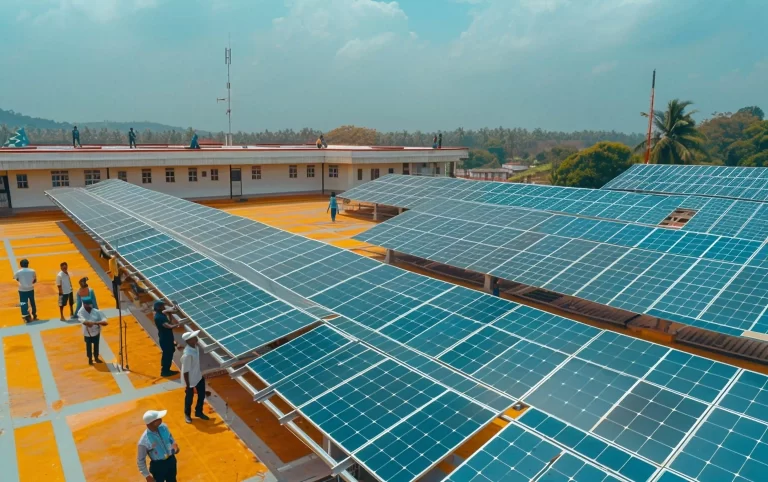
Ascent Energy offers the complete spectrum of industrial solar solutions. The right choice depends on your industry’s energy consumption profile, available rooftop/land area, investment approach, and specific operational requirements.
1. Industrial Rooftop Solar (Captive) — Most Common Starting Point
For most Vadodara factories with available rooftop space on their factory sheds, warehouses, or ancillary buildings, industrial rooftop solar is the most immediate and straightforward solution.
Industrial facilities in GIDC zones typically have large, flat rooftop areas ideally suited to solar panel installation — often accommodating systems of 100 kW to several MW.
How it works: Solar panels are installed on factory rooftops and generate electricity directly used by the factory during production hours. The system connects to the factory’s internal electrical distribution, feeding solar power directly to the load. Any surplus is exported to the grid through net metering.
Key features:
- No land acquisition required
- System generates during peak production hours (daytime coincides with solar generation)
- Net metering credits for surplus export
- Eligible for accelerated depreciation (40% in Year 1)
- GST input tax credit (12%)
- 100% electricity duty exemption on solar-generated power
Typical payback period: 3–5 years Annual ROI: 18–25% System lifetime: 25+ years
Best for: Factories with significant rooftop area in Makarpura GIDC, Waghodia GIDC, Savli GIDC, and other Vadodara industrial estates.
2. Ground-Mounted Captive Solar — For Land-Rich Industrial Operations
For industries with available land adjacent to or near their facility — particularly relevant for larger industrial complexes — ground-mounted captive solar plants deliver higher generation capacity without being constrained by rooftop area.
How it works: Solar panels are mounted on ground-based structures on available land. The plant connects directly to the factory’s electrical system via a dedicated power line.
Advantages over rooftop:
- No structural load considerations for factory roof
- Easier maintenance and cleaning
- Optimal panel orientation and tilt angle — maximising generation
- Can accommodate larger system sizes than rooftop
- Single large plant simpler to operate than multiple rooftop installations
Best for: Large industrial consumers in Vadodara’s outskirts — Karjan, Halol, Padra, Nandesari — with available land and high energy consumption requirements.
3. Open Access Solar — For Large HT Industrial Consumers
Open access solar allows large industrial consumers (typically those with contracted loads above 1 MW) to purchase electricity directly from a solar power plant located anywhere in Gujarat — without being dependent on local DISCOM supply.
How it works: A solar developer sets up a solar plant (on their own land, potentially distant from your factory). Your factory purchases the generated electricity at a pre-agreed rate under a Power Purchase Agreement (PPA). The electricity is wheeled (transmitted) through Gujarat’s grid to your factory.
Financial benefits:
- Solar PPA tariff typically ₹3–5 per unit — significantly below HT grid tariffs
- Exemption from cross-subsidy surcharges (for captive qualifying arrangements)
- Predictable, fixed energy costs for 15–25 years
- Zero capital expenditure
- Directly contributes to RPO compliance
Key considerations:
- Wheeling charges and banking charges apply (typically ₹1.10–1.50/kWh for MSMEs and industrial consumers)
- Requires contracted load above 1 MW (standard for medium to large Vadodara industries)
- Regulatory compliance with GERC open access framework
Best for: Large Vadodara HT consumers — chemical plants, pharmaceutical manufacturers, automotive component makers, and major engineering units — who want significant energy cost reduction without capital deployment.
4. Group Captive Solar — Ideal for GIDC Clusters
Group captive solar is a structure specifically suited to the cluster nature of GIDC industrial estates — where multiple industries operate in proximity and can benefit from a shared solar plant.
Legal framework under Electricity Act 2003: A group captive project must:
- Have participating consumers holding at least 26% equity in the generating company
- Have participating consumers collectively consuming at least 51% of the power generated annually
How it works: Multiple Vadodara industrial units — for example, a group of Makarpura GIDC manufacturers — collectively invest in a solar power plant (typically ground-mounted at a nearby location). Each participant receives solar electricity proportionate to their equity stake, transmitted via open access.
Financial benefits:
- Exemption from cross-subsidy surcharge — the single largest financial benefit, often ₹1–2.5/unit saving on top of tariff savings
- Shared infrastructure cost — more affordable than individual captive plants for medium-sized industries
- Predictable energy costs locked for 20+ years
- Directly meets RPO obligations
- Each participant claims individual tax benefits proportionate to equity
Best for: Medium to large Vadodara GIDC industries (Makarpura, Waghodia, Nandesari) looking to pool resources for maximum savings with regulatory exemptions.
5. Utility-Scale Ground-Mounted Plants
For very large industrial operations — Gujarat Refinery, GACL, major chemical complexes — Ascent Energy develops utility-scale ground-mounted solar plants ranging from several MW to hundreds of MW. These are typically structured as dedicated captive plants or under long-term PPAs, providing base-load renewable energy at competitive tariffs.
6. Solar Carports
An innovative solution for industrial facilities with large vehicle parking areas. Solar panels are mounted on canopy structures over parking areas, generating electricity while simultaneously providing shade for vehicles.
Particularly relevant for large Vadodara industrial campuses with dedicated employee parking and vehicle staging areas — converting unused overhead space into electricity generation without occupying factory floor or production roof space.
Why Industrial Solar ROI Is Exceptional
Industrial solar delivers exceptional financial returns because:
- High electricity tariffs = greater savings per unit Industrial consumers pay ₹7–9/unit. Solar generation costs less than ₹2–3/unit over a system’s lifetime. The saving of ₹5–7/unit is applied across high volumes — 50,000 to 5,00,000 units monthly for a medium to large factory.
- Cross-subsidy exemption adds significant value In captive and group captive models, industries are typically exempt from cross-subsidy surcharges — an additional saving that can add ₹1–2.5 per unit to the financial benefit.
- Demand charge reduction By reducing peak daytime grid consumption through solar generation, industries can lower their maximum demand (MD) readings — which directly reduces fixed demand charges.
- Accelerated depreciation — 40% in Year 1 For CAPEX model industrial solar, the 40% accelerated depreciation in Year 1 provides substantial tax savings — directly reducing effective payback period.
- GST input credit Industrial businesses with GST registration can claim input credit on the 12% GST paid on solar installation.
Sample Industrial Solar ROI — Vadodara Factory (Makarpura GIDC)
Profile: Medium-sized engineering manufacturer, Makarpura GIDC Monthly consumption: 60,000 units (HT connection) Current monthly electricity cost: ₹4,80,000–₹5,40,000 (at ₹8–9/unit blended)
Parameter | Details |
Recommended system size | 500 kW rooftop |
Approximate installation cost | ₹1.8 Cr–₹2.2 Cr |
Monthly solar generation | ~45,000–50,000 units |
Monthly bill reduction | ~₹3,60,000–₹4,50,000 |
Annual electricity savings | ₹4.3 Cr–₹5.4 Cr |
Accelerated depreciation (40%, 30% tax bracket) | ₹21.6L–₹26.4L (Year 1) |
GST input credit (12%) | ₹21.6L–₹26.4L |
Effective Year 1 benefit (savings + tax) | ₹6.5 Cr–₹8 Cr |
Effective payback period | ~2–3 years |
Annual ROI | ~20–25% |
25-year savings | ₹12 Cr–₹15 Cr+ |
Note: Above is illustrative. Actual figures depend on consumption profile, tariff structure, system performance, and tax position. Ascent Energy provides detailed, site-specific financial modelling.
Key Industrial Sectors in Vadodara and Their Solar Potential
Chemical and Petrochemical Industries (Nandesari, Waghodia, Karjan)
One of Vadodara’s most energy-intensive sectors. Chemical plants operate 24/7 with continuous, high power demand. Industrial solar — particularly large rooftop and captive ground-mounted — reduces daytime grid consumption significantly. RPO compliance is a growing regulatory pressure in this sector.
Pharmaceutical Manufacturing (Savli/Manjusar GIDC, Makarpura)
Pharma manufacturing runs clean rooms, HVAC systems, and specialized equipment around the clock. Solar handles daytime loads effectively, reducing operating costs — important in an industry facing pricing pressure. Sustainability credentials are increasingly important for pharma exporters.
Engineering and Auto Components (Makarpura GIDC, Halol)
Engineering workshops and automotive component manufacturers have large factory sheds with extensive rooftop area ideal for solar. Halol’s proximity to major automotive OEMs (and the associated tier-1 supply chain’s energy requirements) makes this a growing solar market.
Textiles and Garment Manufacturing (Por GIDC, Makarpura)
Textile factories run multiple shifts with consistent daytime consumption. Solar aligns well with production hours, delivering strong self-consumption rates and bill reduction.
Food Processing and Cold Storage
High energy consumption for refrigeration and processing. Solar covers a significant portion of daytime electrical load, with hybrid battery options available for cooling system continuity.
Public Sector Units (IOCL, GACL, GAIL, Reliance)
Large PSUs in and around Vadodara have begun significant investments in captive and group captive solar to meet government renewable energy mandates, sustainability targets, and cost reduction objectives. These are multi-MW projects requiring the project management capability of an experienced industrial solar developer like Ascent Energy.
Renewable Purchase Obligations (RPO): Industrial Solar as Compliance Strategy
Under GERC regulations, large electricity consumers in Gujarat are required to purchase or generate a specified percentage of their annual electricity consumption from renewable energy sources. This Renewable Purchase Obligation (RPO) percentage increases over time and is enforced through penalties for non-compliance.
How industrial solar meets RPO:
Solar Model | RPO Credit |
Rooftop captive (own generation) | 100% of generation counts toward RPO |
Ground-mounted captive | 100% of generation counts toward RPO |
Open access solar | Counts toward RPO if structured correctly |
Group captive | Counts toward RPO for each participant |
Renewable Energy Certificates (RECs) | Alternative compliance path if solar not feasible |
For most Vadodara industries subject to RPO, installing industrial solar is simultaneously the lowest-cost compliance path AND the most financially rewarding energy decision — making it doubly compelling.
ESG, Sustainability, and Export Market Pressures
Beyond the financial case, industrial solar in Vadodara is increasingly driven by a third imperative: ESG (Environmental, Social, Governance) compliance and sustainability reporting.
For export-oriented manufacturers in Vadodara — particularly those supplying to European, North American, and Japanese buyers — environmental credentials are becoming a procurement criterion, not just a nice-to-have.
European Carbon Border Adjustment Mechanism (CBAM): From 2026, imports into the EU from high-carbon industries will face carbon border taxes. Vadodara manufacturers in affected sectors (steel, chemicals, cement, engineering) face direct financial exposure unless they can demonstrate low-carbon energy sourcing.
Scope 2 Emissions Reduction: Industrial solar directly reduces a company’s Scope 2 greenhouse gas emissions — the emissions associated with purchased electricity. A 500 kW solar plant at a Makarpura GIDC factory can reduce Scope 2 emissions by 500–700 tonnes of CO₂ per year.
Investor and Lender ESG Requirements: Banks, private equity investors, and institutional lenders are increasingly requiring ESG disclosures and renewable energy commitments from portfolio companies.
Industrial solar in Vadodara is therefore simultaneously a financial investment, a regulatory compliance tool, and an ESG strategy — addressing three separate and growing business imperatives in one installation.

How Ascent Energy Delivers Industrial Solar in Vadodara
Phase 1: Industrial Energy Audit and Site Assessment Ascent Energy’s industrial team conducts a comprehensive energy audit — analysing monthly consumption data, load profiles, peak demand patterns, contracted load, tariff structure, rooftop/land availability, structural assessment, and grid connection type.
Phase 2: Solution Design and Financial Modelling Based on the audit, Ascent Energy designs the optimal industrial solar solution — recommending the right model (rooftop captive, ground-mounted, open access, group captive) and preparing detailed financial projections including savings, payback, ROI, tax benefits, and RPO compliance analysis.
Phase 3: Regulatory and Documentation Management Industrial solar involves complex regulatory processes — net metering applications, GETCO/DISCOM connectivity approvals, GERC open access applications, equity structure documentation for group captive, and statutory approvals. Ascent Energy’s regulatory team manages all of this.
Phase 4: Procurement and EPC Execution High-quality industrial-grade solar components are procured. Ascent Energy’s experienced EPC (Engineering, Procurement, and Construction) team executes the installation to international quality standards — with minimal disruption to production operations.
Phase 5: Commissioning, Monitoring, and O&M Post-commissioning, Ascent Energy provides real-time remote monitoring and planned O&M (Operations and Maintenance) services — ensuring your industrial solar plant operates at peak performance throughout its 25-year lifetime.
Why Choose Ascent Energy for Industrial Solar in Vadodara?
Industrial EPC Expertise: Ascent Energy brings over a decade of industrial solar project experience — from smaller MSME installations to large-scale industrial captive plants. Their understanding of Gujarat’s industrial electricity infrastructure, GETCO grid connectivity, and GERC regulatory framework ensures professional project execution.
Complete Solution Spectrum: From rooftop to ground-mounted, captive to open access, group captive to utility-scale — Ascent Energy offers every industrial solar solution type. This means your optimal solution is designed based on what is right for your business — not what any single vendor happens to offer.
Financial Optimisation Approach: Ascent Energy’s industrial solar proposals are built around maximising your net financial return — not just installing panels. This includes structuring for accelerated depreciation, GST credit optimisation, demand charge reduction, and RPO compliance efficiency.
Reliability and After-Sales Commitment: Industrial solar plants are long-term infrastructure assets. Ascent Energy’s ongoing monitoring and maintenance services ensure your plant continues to deliver its projected returns — year after year, for 25 years.
Conclusion
Industrial solar in Vadodara is no longer an emerging technology or a theoretical option for sustainability-minded pioneers. It is a proven, financially compelling, operationally straightforward solution that is being adopted by manufacturers, chemical plants, pharma companies, and engineering units across every major GIDC estate in the city.
The combination of high industrial electricity tariffs (₹7–9/unit), Gujarat’s exceptional solar resource (5.5–6 peak sun hours daily), cross-subsidy exemptions in captive models, accelerated depreciation, and rising RPO obligations makes the financial case for industrial solar in Vadodara as strong as anywhere in India.
Ascent Energy delivers every industrial solar solution type — rooftop captive, ground-mounted, open access, group captive, utility-scale — with the technical expertise, regulatory knowledge, and financial optimisation capability that Vadodara’s industrial sector demands.
Ready to find out how industrial solar can transform your factory’s energy economics?