
How Solar Rooftop Systems in Vadodara Are Revolutionizing Energy Consumption for Homes and Businesses
Introduction
Something fundamental is changing about the way Vadodara consumes electricity.
For decades, the relationship between a home or business and its power supply was entirely one-directional: electricity flows from the grid to you, and you pay for every unit. The electricity company sets the tariff. Tariffs rise every year. You pay more. There is no alternative.
Solar rooftop systems in Vadodara are ending this one-way relationship.
Today, homeowners in Alkapuri, Gotri, Manjalpur, and Karelibaug, and business owners across Makarpura GIDC, Race Course Road, and Waghodia Road, are generating their own clean electricity from their own rooftops — reducing their grid dependence, cutting their bills by 30–90%, and in many cases, turning their rooftop into a 25-year financial asset that pays them back many times over the initial investment.
This is not a niche technology or a pilot programme. As of 2025, Gujarat leads India in installed rooftop solar capacity — with over 4,300 MW across the state. Vadodara is one of the fastest-growing cities in this solar revolution.
This complete guide explains exactly how solar rooftop systems in Vadodara work, what the installation process involves, how net metering with UGVCL and DGVCL functions, what the technology looks like in 2025, who benefits most, and why Ascent Energy is the right partner to design and install your system.
A solar rooftop system is a complete power generation installation mounted on the roof of a home, commercial building, or factory. It captures sunlight through solar panels and converts it into usable electricity — the same AC electricity that powers every appliance, light, and device in your building.
The key distinction from other forms of solar power is location: the system is on your rooftop, generating power for your consumption, rather than in a distant power plant transmitting electricity across long distribution networks.
This simple distinction — generation at or near the point of consumption — is what makes solar rooftop systems so economically efficient and so transformative for energy consumers in Vadodara.
How Solar Rooftop Systems Work: The Complete Technical Picture
Understanding how your system generates, uses, exports, and manages electricity helps you make the right decisions at every stage.
The Generation Process
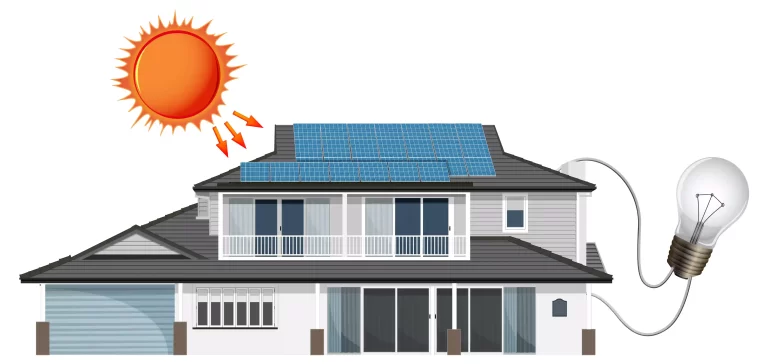
Step 1 — Sunlight to DC Electricity: Solar panels (photovoltaic modules) on your rooftop absorb photons from sunlight and convert them into Direct Current (DC) electricity through the photovoltaic effect. The more sunlight falling on the panels, the more electricity is generated. Vadodara’s average of 5.5–6 peak sun hours per day means your panels are actively generating for a substantial portion of every day.
Step 2 — DC to AC Conversion: The DC electricity from your panels flows into a solar inverter. The inverter converts it into Alternating Current (AC) — the standard form of electricity used by all household and commercial appliances. Modern string inverters, microinverters, and power optimiser-based systems each offer different approaches to this conversion, optimising for different installation conditions.
Step 3 — Powering Your Building: The AC electricity from the inverter flows directly into your building’s electrical panel (distribution board). It powers every connected load — lights, fans, ACs, computers, machinery, refrigeration — in real time, at the moment of generation.
Step 4 — Surplus to the Grid: During periods when your solar system generates more electricity than your building consumes — typically midday on clear days when the sun is at its strongest and some loads are lower — the surplus electricity flows out through your connection to the UGVCL or DGVCL grid.
Step 5 — Net Metering — Credits for What You Export: Your bidirectional electricity meter records both what you import from the grid and what you export to it. Under GERC’s net metering framework, the units you export are credited against your consumption — effectively running your meter backwards. Your monthly bill is the net difference between grid consumption and solar export.
Step 6 — Grid Power for Evenings and Overcast Days: At night, during cloudy periods, or whenever your solar generation is insufficient, your building draws from the grid as usual. Net metering credits from surplus daytime export reduce the cost of this grid consumption.
Solar Rooftop System Components: What Goes on Your Roof and in Your Building
1. Solar Panels (PV Modules)
The panels are the most visible component — the glass-fronted rectangles on your roof that capture sunlight. In 2025, the technology has evolved dramatically:
Monocrystalline panels: The current standard for residential and commercial rooftops. Made from single-crystal silicon, they offer efficiency ratings of 20–24% — meaning they convert 20–24% of received sunlight into electricity. Compact, aesthetically clean, and highly efficient in Vadodara’s abundant sunshine.
Bifacial panels: Advanced panels that generate electricity from both the front (direct sunlight) and rear surface (reflected light from the roof). Particularly effective on light-coloured or reflective rooftop surfaces — generating 5–15% more electricity than standard panels of the same size.
TOPCon and HJT panels: The latest generation of high-efficiency residential and commercial panels, with efficiencies approaching 24–26%. Premium cost, premium performance — increasingly common in new Vadodara installations.
Panel performance in Vadodara: A single 500W panel in Vadodara’s sunshine generates approximately 1.8–2.2 kWh per day (approximately 55–66 kWh per month). A 5 kW residential system with 10 such panels generates 450–500 kWh per month — enough to meet most 2–3BHK household requirements.
2. Solar Inverter
The inverter is the brain of your solar system — managing the conversion, monitoring, and communication functions. Types relevant to Vadodara installations:
String Inverter: The most common choice for standard residential and commercial rooftops. All panels connect in a series “string” to one central inverter. Simple, cost-effective, and reliable. Best for rooftops with consistent, unobstructed sunlight exposure.
Microinverter: An individual micro-inverter is attached to each panel, converting DC to AC at panel level. Ideal for rooftops with partial shading, multiple orientations, or complex layouts. If one panel underperforms due to shading or soiling, it does not affect the output of other panels. Higher upfront cost, maximum output optimisation.
Hybrid Inverter (with Battery Management): For hybrid solar systems with battery storage. Manages power flows between panels, batteries, and the grid simultaneously. The right choice if you want backup power during outages alongside grid-connected solar benefits.
3. Mounting Structure
The aluminium or hot-dip galvanised steel structure that holds your panels on the roof at the optimal angle for solar generation. Critical for performance and safety.
Roof types in Vadodara:
- RCC/concrete flat roofs (most common in residential apartments and commercial buildings) — fixed tilted structures at 10–25° angle for optimal seasonal performance
- Metal sheet roofs (industrial sheds in GIDC areas) — purpose-designed metal roof mounting with minimal penetration
- Tiled/sloped roofs (bungalows, independent houses) — in-roof or on-roof mounting solutions
Ascent Energy’s mounting structures are engineered for Gujarat’s wind speed requirements and monsoon season loads — ensuring your installation remains safe and stable for 25+ years.
4. AC and DC Distribution Boards (ACDB/DCDB)
Safety and protection equipment at both the DC (panel-to-inverter) and AC (inverter-to-grid) interfaces. Includes surge protection devices, circuit breakers, and disconnect switches — ensuring safe operation and facilitating maintenance.
5. Bidirectional Net Meter
Once your solar system is commissioned and UGVCL/DGVCL approves your net metering application, your standard single-direction electricity meter is replaced with a bidirectional meter that measures:
- Units imported from the grid (when solar is insufficient)
- Units exported to the grid (when solar is surplus)
Your monthly bill is calculated on the net difference — import minus export — plus fixed charges. Monthly excess export credits carry forward and are settled annually at the APPC (Average Power Purchase Cost) rate.
6. Monitoring System
Modern solar rooftop systems in Vadodara include real-time monitoring through smartphone apps and web portals. You can track:
- Live generation (kW being generated right now)
- Daily, monthly, and lifetime energy generation (kWh)
- Estimated CO₂ emissions avoided
- System performance ratio and alerts for underperformance
- Export and import data aligned with your net meter readings
Net Metering in Vadodara: How UGVCL and DGVCL Handle Your Solar Credits
Net metering is the financial engine of rooftop solar in Vadodara. Understanding how UGVCL and DGVCL handle your credits ensures you maximise the benefit.
Which DISCOM Covers Your Vadodara Property?
Vadodara city and surrounding areas are served by two distribution companies:
- UGVCL (Uttar Gujarat Vij Company Limited): Covers northern and central Vadodara including areas like Alkapuri, Fatehgunj, Sayajigunj, Karelibaug, Chhani, Harni, Makarpura, and Nizampura
- DGVCL (Dakshin Gujarat Vij Company Limited): Covers southern Vadodara areas including Manjalpur, Waghodia Road, Tarsali, Atladara, and surrounding areas
Ascent Energy’s team identifies your DISCOM and handles all applications and approvals with the appropriate utility.
How GERC Net Metering Works in 2025
The Gujarat Electricity Regulatory Commission (GERC) Third Amendment Regulations (2022) govern net metering for rooftop solar in Gujarat:
- Eligible system size: 1 kW to 1 MW (net metering framework)
- Systems above 10 kW: May choose net metering or gross metering
- System size limit: Cannot exceed your sanctioned load or 1 MW, whichever is lower
- Monthly settlement: Surplus export credits carry forward each month
- Annual settlement: At year-end, any remaining export credits are settled at APPC (Average Power Purchase Cost) rate
- Credit rollover: Excess generation credits carry forward for 12 months
The Net Metering Approval Process in Vadodara
Ascent Energy manages the complete net metering process on your behalf:
Step 1 — Feasibility Application Submit technical details (proposed system size, load information, SLD diagram) to UGVCL/DGVCL. DISCOM must complete feasibility check within 3 working days under 2024 regulatory guidelines.
Step 2 — Technical Approval DISCOM approves the technical feasibility — confirming the local grid can accommodate your system’s export capacity.
Step 3 — System Installation Ascent Energy completes installation per the approved design. GPS-tagged photographs of the installation are uploaded to the national PM Surya Ghar portal (for residential subsidies).
Step 4 — DISCOM Inspection UGVCL/DGVCL officials inspect the installation to confirm it meets specifications and safety standards.
Step 5 — Net Meter Installation The DISCOM replaces your existing meter with a bidirectional net meter. A metering agreement is signed.
Step 6 — Commissioning Certificate and Subsidy Release A commissioning certificate is generated. For residential installations, the PM Surya Ghar subsidy (up to ₹78,000) is released to your bank account — typically within 15 days of DISCOM approval.
Your system is now live — exporting surplus power and earning credits from Day 1.
Types of Solar Rooftop Systems Available in Vadodara
Ascent Energy offers three distinct solar rooftop configurations to match different building types, consumption patterns, and investment objectives:
On-Grid Solar Rooftop System — The Most Popular Choice
Connected to the UGVCL/DGVCL grid. No battery storage. Net metering handles surplus export.
Advantages:
- Lowest cost — no expensive batteries
- Net metering maximises financial return
- Eligible for PM Surya Ghar subsidy (residential)
- Requires no maintenance for battery systems
- Grid supplies power at night and during overcast periods
Consideration:
- Does not supply power during grid outages (safety requirement)
Best for: Most Vadodara homeowners and businesses with reliable grid supply.
Off-Grid Solar Rooftop System — Complete Independence
No grid connection. Battery storage provides power day and night.
Advantages:
- Complete energy independence
- Power available regardless of grid status
- Ideal for properties with unreliable grid supply
Consideration:
- Higher cost (battery storage is expensive)
- Not eligible for net metering or residential subsidies
Best for: Remote properties, farmhouses, and locations with unreliable UGVCL/DGVCL supply.
Hybrid Solar Rooftop System — Best of Both Worlds
Grid-connected AND battery-equipped. Solar charges batteries during the day; batteries supply power at night and during outages.
Advantages:
- Power during grid outages (unlike on-grid)
- Net metering still available for surplus export
- Battery stores solar energy for evening use — reducing grid import
- Maximum energy security
Consideration:
- Higher upfront cost than on-grid; lower than off-grid for equivalent battery capacity
Best for: Vadodara homeowners and businesses who want grid-connected solar savings but also need power continuity during outages.
Solar Rooftop Benefits: Transforming Energy Consumption in Vadodara
For Residential Consumers
Financial transformation: A correctly sized residential solar rooftop system typically reduces a Vadodara household’s monthly electricity bill by 60–90%. For a 3BHK household spending ₹3,000–₹5,000 per month on electricity, this represents annual savings of ₹20,000–₹45,000. Over 25 years — accounting for Gujarat’s steady tariff increases — total savings routinely exceed ₹8–12 lakhs.
Energy independence: With a solar rooftop system, you become a prosumer — both consumer and producer of electricity. Your home is no longer purely dependent on the grid for every unit of power it uses.
Property value uplift: Solar rooftop installations are now recognised as property value-enhancing infrastructure in Vadodara’s real estate market. Homes with existing solar installations command premium valuations and are quicker to sell — particularly in areas like Gotri, Alkapuri, Vasna, and newer residential townships.
Environmental contribution: A 5 kW residential solar system in Vadodara prevents approximately 5–6 tonnes of CO₂ emissions per year — equivalent to planting approximately 80–100 trees annually.
For Commercial Consumers (Offices, Retail, Hospitality)
Direct operating cost reduction: Commercial electricity tariffs in Gujarat can reach ₹8–9 per unit. A rooftop solar system generating 50–80% of a commercial building’s daytime consumption directly reduces this cost to the effective solar generation cost of ₹2–3 per unit — a saving of ₹5–7 per unit on every self-consumed unit.
Brand and sustainability value: Green energy credentials matter increasingly to tenants, customers, and corporate clients. Solar-powered commercial premises demonstrate environmental responsibility — now a genuine competitive differentiator.
No capital outlay for some businesses: Through Ascent Energy’s OPEX/RESCO arrangements, commercial consumers can access rooftop solar benefits with zero upfront capital — paying only for generated electricity at a PPA tariff below grid rates.
For Industrial Consumers
Highest absolute savings: Industrial electricity tariffs (₹7–9/unit) combined with high consumption volumes mean industrial rooftop solar delivers the largest absolute financial savings of any consumer category.
Demand charge reduction: Rooftop solar reduces grid import during peak daytime hours — directly lowering maximum demand (MD) readings and the associated demand charges component of the industrial electricity bill.
RPO compliance: Industrial rooftop solar directly meets Renewable Purchase Obligations — turning a regulatory requirement into a financial return.
Solar Rooftop System Costs in Vadodara (2025)
System Size | Rooftop Area Required | Approximate Cost | Residential Subsidy | Net Cost |
1 kW | 10–12 sq.m. | ₹55,000–₹70,000 | ₹30,000 | ₹25,000–₹40,000 |
2 kW | 20–24 sq.m. | ₹1,00,000–₹1,30,000 | ₹60,000 | ₹40,000–₹70,000 |
3 kW | 30–36 sq.m. | ₹1,40,000–₹1,80,000 | ₹78,000 | ₹62,000–₹1,02,000 |
5 kW | 50–60 sq.m. | ₹2,20,000–₹2,80,000 | ₹78,000 | ₹1,42,000–₹2,02,000 |
10 kW | 100–120 sq.m. | ₹4,20,000–₹5,00,000 | ₹78,000 (res.) | ₹3,42,000–₹4,22,000 |
50 kW | 500–600 sq.m. | ₹20,00,000–₹25,00,000 | N/A (commercial) | ₹17,60,000–₹22,00,000 (after GST credit) |
Note: Commercial and industrial installations do not receive PM Surya Ghar subsidy but benefit from accelerated depreciation (40%) and GST input credit (12%). Costs are approximate and vary based on technology, inverter type, roof complexity, and components selected.
Vadodara's Solar Rooftop Revolution: Neighbourhood by Neighbourhood
Ascent Energy installs solar rooftop systems across every part of Vadodara. Here is where the solar revolution is most visibly reshaping energy consumption:
Gotri, Vasna-Bhayli Road, Sama: New residential townships with large, flat terrace areas ideal for rooftop solar. Young professional homeowners and families are adopting solar at high rates.
Alkapuri, Akota, Fatehgunj: Established residential areas with independent bungalows and older apartments. Growing interest in solar as residents experience compounding electricity bill increases.
Manjalpur, Karelibaug, Waghodia Road: Dense residential zones where large apartment complexes and housing societies are exploring society-level solar installations to reduce common area electricity costs.
Sayajigunj, Raopura, Dandia Bazar: Commercial districts where offices, retail shops, and small businesses are adopting rooftop solar to cut operational costs.
Makarpura, Waghodia GIDC, Savli, Nandesari: Industrial zones where factory rooftop solar is delivering massive savings on high-volume electricity bills.
Chhani, Harni, Atladara, Gorwa: Rapidly developing areas where residential and semi-commercial adoption is accelerating as awareness grows.
Ascent Energy's Rooftop Solar Installation: What Sets Them Apart
Decade of Local Expertise: Ascent Energy has designed and installed solar rooftop systems across Vadodara for over a decade. Their familiarity with local grid conditions, UGVCL and DGVCL processes, monsoon engineering requirements, and Vadodara’s diverse building stock means every installation is optimised for local conditions.
High-Quality, Long-Life Components: Ascent Energy specifies high-efficiency solar panels and inverters from established manufacturers — ensuring 25-year performance warranties are backed by components that genuinely last. Not all solar installers in Vadodara offer the same component quality standards.
Complete End-to-End Service: From your initial free site assessment to DISCOM net meter commissioning, subsidy processing, and ongoing maintenance — Ascent Energy manages the entire process. You do not need to navigate government portals, DISCOM applications, or technical compliance independently.
All System Types, All Consumer Categories: Residential 1–10 kW rooftop systems; commercial 10–500 kW systems; industrial rooftop up to several MW; on-grid, off-grid, and hybrid configurations; with or without battery storage — Ascent Energy’s technical capability covers the complete spectrum.
Solutions Beyond Rooftop: For clients whose rooftop capacity is insufficient for their energy requirements, Ascent Energy’s capabilities extend to ground-mounted captive solar, open access, group captive, and solar carports — ensuring every Vadodara energy consumer can access the optimal solar solution regardless of rooftop constraints.
Conclusion
Solar rooftop systems in Vadodara are not a future technology — they are the present reality for thousands of homeowners, businesses, and industries across the city who have chosen to take control of their energy costs and generate their own clean electricity.
The economics are compelling. The technology is proven. The government support — through PM Surya Ghar subsidies for residential consumers and GERC net metering for all categories — has never been stronger. And Vadodara’s sunshine — 5.5–6 peak hours per day on average — means every rooftop in the city is a potential power plant.
The only question is when you will make your rooftop work for you.
Ascent Energy brings over a decade of rooftop solar expertise to Vadodara — delivering custom-designed, high-quality, fully managed solar installations for homes, businesses, and industries across every neighbourhood in the city.
Ready to turn your rooftop into a 25-year energy asset?