
How Solar Energy Is Fighting Air Pollution in Gujarat: Why Every Factory and Home Should Switch Now
Introduction
If you have driven through Vadodara on a winter morning, you have seen it — the grey-brown haze that settles over the city when temperature inversions trap pollutants close to the ground. You have smelled the acrid edge in the air near Nandesari Industrial Estate. You have read the AQI (Air Quality Index) alerts warning sensitive groups to stay indoors.
Vadodara’s air quality — like that of most of Gujarat’s industrial cities — is under significant pressure. Gujarat’s extraordinary industrial output, its dense road traffic, and its coal-heavy electricity generation create a confluence of pollutants that affects the health and quality of life of every resident.
Solar energy is one of the most powerful tools available to directly address this problem — and it is available to every home, business, and factory in Vadodara right now.
This blog explains exactly how solar energy fights air pollution in Gujarat, the specific pollutants it eliminates, and why switching to solar is both an environmental and a public health decision — not just a financial one.
The Sources of Gujarat’s Air Pollution
Gujarat’s air quality is affected by multiple overlapping pollution sources:
Thermal Power Generation: Gujarat’s power grid relies significantly on coal-fired thermal plants. Coal combustion releases CO₂, SO₂, NOₓ, particulate matter, mercury, and other toxic compounds directly into the atmosphere. Every unit of electricity consumed from Gujarat’s grid carries an invisible pollution cost.
Industrial Emissions: Gujarat’s chemical clusters — particularly around Ankleshwar, Nandesari, Waghodia, and Bharuch — generate significant industrial air pollution from manufacturing processes. Many of these industries also consume large quantities of grid electricity, adding to their indirect emissions.
Vehicular Pollution: Vadodara’s growing vehicle fleet contributes NOₓ, PM2.5, and volatile organic compounds (VOCs) to the urban air mix.
Construction Dust: Rapid urbanisation generates construction dust that significantly worsens PM10 concentrations.
The Health Impact
Respiratory disease: Chronic exposure to PM2.5 — fine particles below 2.5 micrometres that penetrate deep into lung tissue — increases the risk of chronic bronchitis, COPD, and lung cancer. Gujarat’s industrialised cities have elevated PM2.5 concentrations.
Cardiovascular disease: Air pollution is now recognised as a major cardiovascular risk factor contributing to heart attacks, strokes, and heart failure through systemic inflammation.
Children’s health: Growing lungs are particularly vulnerable to air pollution. Children in highly polluted areas develop smaller lung capacity, more frequent respiratory infections, and higher rates of asthma.
Economic cost: The WHO estimates that air pollution costs India approximately 1.4% of GDP annually in healthcare costs and lost productivity with industrial states bearing a disproportionate share.
How Solar Energy Directly Reduces Air Pollution
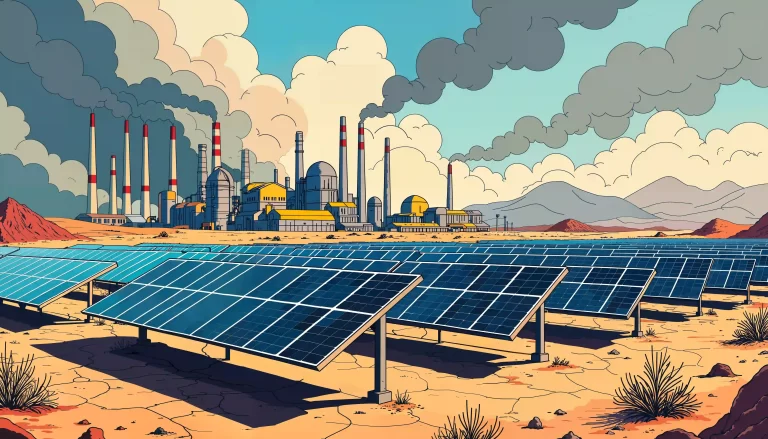
When you install solar panels in Vadodara, you replace grid electricity — generated primarily from coal — with clean, zero-emission solar power. This is not a metaphorical or indirect benefit. It is a direct, calculable reduction in the specific pollutants that are degrading Vadodara’s air.
CO₂ — The Primary Greenhouse Gas
Every unit of DGVCL grid electricity releases approximately 0.82 kg of CO₂. A 3 kW home solar system generates 4,500 units annually — preventing 3,690 kg of CO₂ per year.
A 500 kW industrial solar plant in Makarpura GIDC generates 7,00,000 units annually — preventing 5,74,000 kg (574 tonnes) of CO₂ per year.
These are not marginal improvements. At scale — if all eligible rooftops in Vadodara installed solar — the city’s electricity-related CO₂ emissions could drop by hundreds of thousands of tonnes annually.
SO₂ — The Acid Rain Precursor
Sulphur dioxide from coal combustion is a major contributor to acid rain, which damages forests, acidifies water bodies, and corrodes buildings. It is also a direct respiratory irritant that worsens asthma and lung disease.
Gujarat’s coal plants collectively emit thousands of tonnes of SO₂ annually. Every kWh of solar electricity generated in Vadodara directly displaces coal generation and reduces SO₂ emissions proportionally. Solar panels produce zero sulphur dioxide.
NOₓ — The Smog Former
Nitrogen oxides (NOₓ) react with sunlight and VOCs to form ground-level ozone — the main component of smog. Ground-level ozone causes respiratory distress, eye irritation, and long-term lung damage.
Coal and gas power plants are major NOₓ emitters. Industrial processes add further NOₓ to Gujarat’s air. Solar energy produces zero NOₓ during operation.
PM2.5 and PM10 — The Silent Killers
Fine and coarse particulate matter from coal combustion is directly linked to premature death from respiratory and cardiovascular disease. PM2.5 is particularly dangerous because it bypasses the respiratory tract’s natural filters and enters the bloodstream.
Solar panels produce zero particulate matter.
Mercury — The Neurological Toxin
Coal plants are the world’s largest human source of mercury pollution. Mercury in the atmosphere deposits in water bodies where bacteria convert it to methylmercury — which enters the food chain and accumulates in fish, ultimately affecting human neurological health.
Gujarat’s coal plants contribute to mercury deposition across the region. Solar energy produces zero mercury emissions.
The Scale of Pollution Prevented by Solar in Vadodara
To make these benefits concrete, consider what Vadodara’s existing solar installations have already achieved — and what full adoption could deliver:
If every eligible home in Vadodara (estimated 500,000 households) installed 3 kW solar:
- Total solar capacity: 1,500 MW
- Annual generation: 2.1 billion units
- Annual CO₂ prevented: 1.7 million tonnes
- Equivalent to: Planting 85 million trees or removing 365,000 cars from the road
If every eligible factory in Vadodara’s GIDC estates installed rooftop solar:
- Estimated total capacity: 2,000+ MW
- Annual CO₂ prevented: 2.3 million tonnes
- Additional SO₂ prevented: Thousands of tonnes
- PM2.5 prevented: Hundreds of tonnes
These are not theoretical numbers. They are achievable within this decade if solar adoption continues at pace.
Why Industrial Units in Vadodara Have the Most to Gain
Gujarat’s industries are both the largest consumers of electricity and the largest contributors to air pollution. This makes industrial solar adoption simultaneously the highest-impact environmental action and the highest-ROI financial investment.
Chemical and petrochemical plants (Nandesari, Waghodia, Karjan): These facilities consume enormous amounts of electricity. A chemical plant consuming 5 lakh units per month — installing 3.5 MW of solar — prevents approximately 4,900 tonnes of CO₂ annually. Beyond the environmental benefit, this directly reduces CBAM liability and strengthens the plant’s environmental compliance position.
Pharmaceutical manufacturers (Savli GIDC, Makarpura): International pharma customers and regulatory authorities increasingly scrutinise the environmental footprint of manufacturing operations. Solar-powered pharmaceutical production is a genuine competitive advantage in export markets.
Engineering and automotive (Makarpura GIDC, Halol): With global automotive OEMs demanding Scope 2 emission reductions from their supply chains, Tier 1 and Tier 2 suppliers in Vadodara’s automotive cluster face direct commercial pressure to adopt renewable energy.
The message is clear: In 2026, industrial solar in Vadodara is no longer just about cost savings. It is about competitive survival in an increasingly carbon-conscious global economy.
The Connection Between Your Electricity Bill and Vadodara's Air
Most Vadodara residents do not make the connection between their monthly DGVCL bill and the air they breathe. But the connection is direct and quantifiable:
Every ₹1,000 electricity bill in Vadodara represents approximately 150 units of grid electricity — and approximately 123 kg of CO₂, along with proportional amounts of SO₂, NOₓ, and PM2.5.
When you pay your electricity bill, you are not just paying for electricity. You are indirectly funding the combustion of coal, the release of pollutants, and the degradation of the air that your children breathe.
Installing solar panels does not just save you money. It physically removes your household or business from the pollution chain.
Solar Energy and Vadodara's Public Health Emergency
India’s State of Global Air report consistently ranks Gujarat’s cities among India’s most polluted. Vadodara, while not in the extreme category of north Indian cities, faces real and growing air quality challenges from its industrial base and urban growth.
The health costs are paid by every Vadodara resident in hospital visits for respiratory illness, in reduced productivity from chronic health conditions, in the irreversible lung damage that accumulates over years of exposure to elevated PM2.5.
Solar energy adoption — at scale, across homes, businesses, and industries — is one of the most practical, immediately deployable tools Vadodara has to improve its air quality. Unlike emission control at power plants (which requires large capital investment by utilities) or traffic management (which requires policy changes), solar installation on your own roof is something you can do this month.

What Ascent Energy Is Doing for Vadodara's Air Quality
Every solar installation Ascent Energy completes in Vadodara is a measurable contribution to the city’s air quality. Since our first installation in 2012, the cumulative solar capacity we have installed has prevented hundreds of thousands of tonnes of CO₂ and significant quantities of SO₂, NOₓ, and particulate matter from entering Vadodara’s atmosphere.
We track and report the environmental impact of our installations — providing customers with their annual CO₂ prevention data through the monitoring app included with every system. We believe solar customers deserve to see not just the financial return of their investment, but the environmental return as well.
Conclusion
Solar energy and air pollution in Gujarat are directly, measurably connected. Every solar panel installed in Vadodara eliminates a specific quantity of carbon dioxide, sulphur dioxide, nitrogen oxides, particulate matter, and mercury that would otherwise be released by coal combustion to generate the same electricity.
The air quality of Vadodara’s future depends on decisions being made today — by homeowners, business owners, and factory managers who can either continue purchasing polluting grid electricity or switch to clean solar generation.
The technology is proven. The economics are compelling. The subsidies have never been better. And the environmental urgency has never been greater.
Ascent Energy is ready to help every Vadodara home, business, and industry make the switch — with expert engineering, genuine components, and complete support from first call to final commissioning.
📞 Call: +91 82007 85076
📧 Email: energyascent@gmail.com
🌐 ascentenergy.in/contact-us/
📍 Vadodara, Gujarat