Floating Solar & Agrivoltaics: The Future of Land-Efficient Solar Power in India
India’s solar capacity is growing fast, but there’s a silent challenge slowing things down: land availability.
Large solar projects require vast areas of land. As urbanization increases and agricultural land becomes more valuable, finding suitable space for solar installations is becoming harder and more expensive. This challenge has led to the rise of land-efficient solar technologies, specifically floating solar and agrivoltaics.
These innovations allow India to expand solar capacity without competing for land, making them critical to the future of renewable energy.
Why Land Scarcity Is a Major Challenge for Solar in India
Traditional ground-mounted solar plants require:
- Large open land parcels
- High land acquisition costs
- Long approval timelines
- Environmental clearances
In a country like India where land is scarce, expensive, and politically sensitive, this creates delays and resistance. To achieve long-term renewable energy targets, India needs
smarter solar deployment models.
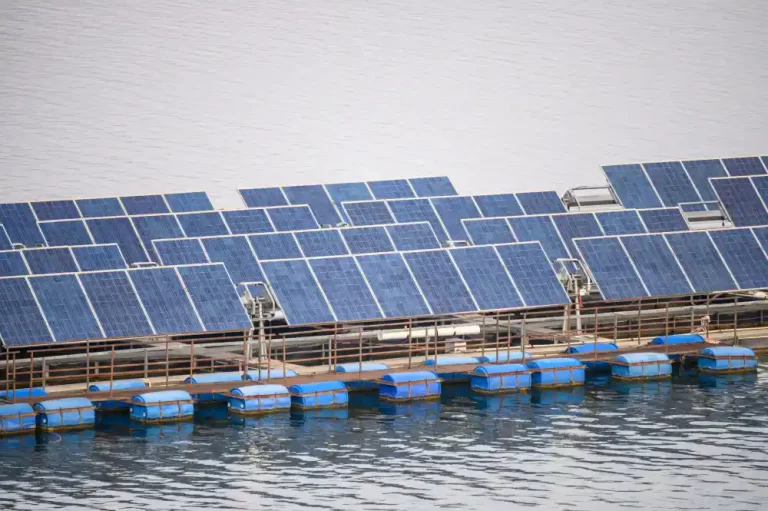
What Is Floating Solar Power?
Floating solar power, also known as floatovoltaics, involves installing solar panels on water bodies such as:
- Reservoirs
- Lakes
- Dams
- Canals
- Industrial water ponds
Instead of occupying land, solar panels float on specially designed structures anchored to the water surface.
How Floating Solar Systems Work
- Solar panels are mounted on floating platforms
- Platforms are anchored to prevent movement
- Underwater cables transmit electricity to shore
- Power is fed into the grid or used locally
The water below helps cool the panels, improving efficiency.
Key Benefits of Floating Solar
1. No Land Requirement
Floating solar uses unused water surfaces, preserving valuable land for agriculture and development.
2. Higher Efficiency
Water cooling improves panel performance, increasing energy generation compared to land-based systems.
3. Reduced Water Evaporation
Panels reduce direct sunlight on water, cutting evaporation losses significantly.
4. Ideal for Industrial & Utility Projects
Industries with water reservoirs can generate clean energy on-site.
Floating Solar in India: Growing Rapidly
India has already launched multiple floating solar projects on reservoirs and dams. With large water infrastructure across states, floating solar is becoming a scalable national solution.
Government bodies and industrial operators are increasingly exploring this model to meet sustainability goals.
What Is Agrivoltaics?
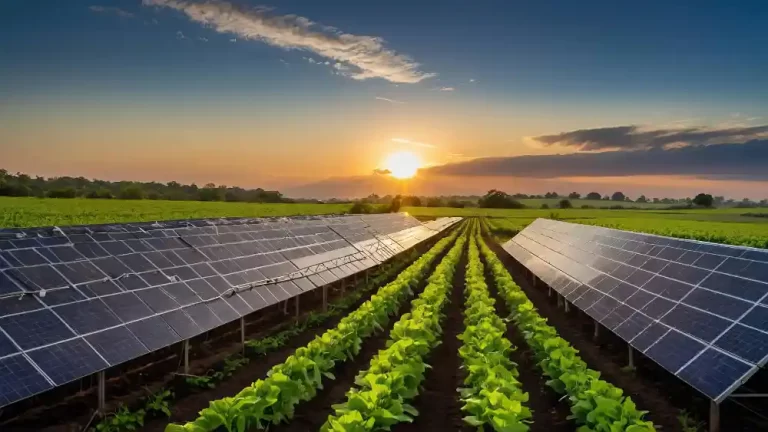
Agrivoltaics is a system where
solar panels and agriculture coexist on the same land. Instead of replacing farmland, solar installations are designed to work alongside crops.
Panels are mounted:
- Higher above ground
- With wider spacing
- To allow sunlight penetration
This allows farming activities to continue underneath
How Agrivoltaics Works
- Crops grow below solar panels
- Panels generate electricity above
- Microclimate improves crop health
- Farmers earn additional income
This dual-use model maximizes land productivity.
Benefits of Agrivoltaics for India
1. Dual Income for Farmers
Farmers earn from crop production and solar power generation.
2. Improved Crop Yield
Partial shade reduces heat stress and water loss for certain crops.
3. Reduced Water Consumption
Lower evaporation improves soil moisture retention.
4. Farmer Acceptance of Solar
Agrivoltaics removes resistance to solar projects on farmland.
Crops Suitable for Agrivoltaic Systems
Agrivoltaics works well with:
- Vegetables
- Pulses
- Leafy greens
- Certain grains
- Fodder crops
Crop selection depends on regional climate and sunlight requirements.
Floating Solar vs Agrivoltaics: Which Is Better?
Both technologies solve different problems.
| Factor |
Floating Solar |
Agrivoltaics |
| Land usage |
No land required |
Dual land use |
| Ideal for |
Reservoirs, dams |
Farmlands |
| Water savings |
Yes |
Indirect |
| Farmer income |
No |
Yes |
| Installation complexity |
High |
Medium |
India needs both, not one over the other
Why These Technologies Matter for India’s Solar Future
India aims to expand renewable energy rapidly while:
- Protecting agricultural land
- Reducing environmental impact
- Ensuring farmer livelihoods
- Managing water resources
Floating solar and agrivoltaics directly address these concerns.
Commercial and Industrial Opportunities
Industries can benefit from:
- Floating solar on water storage tanks
- Reduced electricity costs
- Improved ESG compliance
- Land cost savings
Agrivoltaics also opens opportunities for:
- Agri-industrial zones
- Rural solar entrepreneurship
- Cooperative solar farming models
Challenges and Considerations
While promising, these systems require:
- Proper engineering design
- Skilled EPC partners
- Long-term maintenance planning
- Site-specific feasibility analysis
Poor design can reduce efficiency or harm crops, making expert execution critical.
Role of EPC Companies in Advanced Solar Projects
Innovative solar solutions demand:
- Detailed feasibility studies
- Customized system design
- Quality components
- Long-term performance monitoring
Choosing the right EPC partner ensures reliability, safety, and optimal returns.
The Road Ahead for Land-Efficient Solar in India
As land becomes more valuable and sustainability pressures rise, India will increasingly rely on:
- Floating solar installations
- Agrivoltaic farming models
- Hybrid renewable projects
These technologies are not experimental anymore. They are becoming
mainstream solutions for large-scale clean energy expansion.
Conclusion
Floating solar and agrivoltaics represent the next phase of solar evolution in India. They solve the land constraint problem while unlocking new economic and environmental benefits.
By adopting land-efficient solar technologies, India can scale renewable energy without sacrificing agriculture, water resources, or development goals.